Banco de Questões

A ferramenta completa para a sua preparação em concursos

Questões de Língua Inglesa

35.421 questões encontradas

  1. Questão 121

    ID 3172447

    Disciplina: Língua Inglesa

    Assunto: Notícias e Artigos Jornalísticos | News Articles

    Ano: 2023 Banca: FGV - Fundação Getúlio Vargas Órgão: Tribunal de Contas do Estado de São Paulo


    READ THE TEXT AND ANSWER QUESTIONS 26 TO 30:

    Chatbots could be used to steal data, says cybersecurity agency

    The UK’s cybersecurity agency has warned that there is an increasing risk that chatbots could be manipulated by hackers.

    The National Cyber Security Centre (NCSC) has said that individuals could manipulate the prompts of chatbots, which run on artificial intelligence by creating a language model and give answers to questions by users, through “prompt injection” attacks that would make them behave in an unintended manner.

    The point of a chatbot is to mimic human-like conversations, which it has been trained to do through scraping large amounts of data. Commonly used in online banking or online shopping, chatbots are generally designed to handle simple requests.

    Large language models, such as OpenAI’s ChatGPT and Google’s AI chatbot Bard, are trained using data that generates human-like responses to user prompts. Since chatbots are used to pass data to third-party applications and services, the NCSC has said that risks from malicious “prompt injection” will grow.

    For instance, if a user inputs a statement or question that a language model is not familiar with, or if they find a combination of words to override the model’s original script or prompts, the user can cause the model to perform unintended actions.

    Such inputs could cause a chatbot to generate offensive content or reveal confidential information in a system that accepts unchecked input.

    According to the NCSC, prompt injection attacks can also cause real world consequences, if systems are not designed with security. The vulnerability of chatbots and the ease with which prompts can be manipulated could cause attacks, scams and data theft. The large language models are increasingly used to pass data to third-party applications and services, meaning the risks from malicious prompt injection will grow.

    The NCSC said: “Prompt injection and data poisoning attacks can be extremely difficult to detect and mitigate. However, no model exists in isolation, so what we can do is design the whole system with security in mind.”

    The NCSC said that cyber-attacks caused by artificial intelligence and machine learning that leaves systems vulnerable can be mitigated through designing for security and understanding the attack techniques that exploit “inherent vulnerabilities” in machine learning algorithm.

    Adapted from: The Guardian, Wednesday 30 August 2023, page 4.


    In “Large language models, such as OpenAI’s ChatGPT and Google’s AI chatbot Bard” (4th paragraph), “such as” introduces a(n):

    Alternativas da questão 3172447
  2. Questão 122

    ID 3172446

    Disciplina: Língua Inglesa

    Assunto: Análise Sintática | Parsing

    Ano: 2023 Banca: SELECON - Instituto Nacional de Seleções e Concursos Órgão: Secretaria de Estado de Educação de Mato Grosso


    TEXT:

    How do people overcome fossilization and achieve nativelike fluency in second language acquisition?

    There are a lot of common misconceptions about fossilization and language development. It's impossible to correct all of them in a post here, but I'll address a few that have been mentioned below.

    Fossilization is a stage at which a second language speaker seems to cease making progress toward becoming more targetlike in his or her use of the language, so a "learning plateau" is a reasonable analogy. The comparison wherein "the L2 learner has his own linguistic system" that's still influenced by L1 and other things is known as the "interlanguage." The question researchers cannot conclusively answer is whether or not that "plateau" is reversible after a certain point, be it age, fluency level, etc., in order to start making progress again.

    Different people are motivated by different things, which range from need (to pass a test, to get a job, to watch movies without subtitles, to make friends, etc.) to learning style (preferring to study from texts, liking/disliking impromptu, small-talk with people just to practice, preference for/against learning formal rules, and aptitude). It is easy to remember verb conjugations. There is no single formula.

    Finding someone who can correct your errors tactfully and effectively most certainly does not need to be demotivating, depressing or draining whatsoever. I'm a very fluent non-native speaker of Spanish, and I actively request that my native speaker (NS) friends correct me when I make a mistake, or use a phrase that sounds funny in their dialect, etc. How else will I learn? It's fascinating to learn little details like that now after so many years. As long as they don't do it in a mocking or condescending way, or at a socially inappropriate time, why wouldn't I want their help? Of course, if you correct a beginner every time they try to utter a sentence, it could be discouraging - and obnoxious - but everything in moderation.

    One of the biggest cognitive challenges is whether or not L2 speakers can learn to consciously notice differences between their L2 efforts and the way a NS talks. There are decades of research on this (my own included) and I'll gladly give references if anyone actually cares. Noticing falls into two broad categories. First, the ability to "notice the gap," i.e. hear a NS say a sentence and think, "Hmm, I understand what he meant but I've never heard that word before; it must mean ___" or "I know what he meant but it would not have occurred to me to say it that way; I'll try to remember that for later." The second is the ability to "notice the hole," i.e. when the L2 learner is trying to speak/ write and realizes that his "interlanguage" lacks a word, sound or structure needed to accurately convey his own thought. If he can seek the input necessary to fill the hole, he has a much stronger chance of acquiring it. The thought processes involved during that moment are holding the forms (or lack thereof) in working memory, and the longer it stays there for further processing, the greater the possibility that it is retained in long-term memory for later use. The NS interlocutor can help promote noticing through corrective feedback (also a subject of decades of research, for which I'm also happy to provide resources if anyone is genuinely interested.)

    I have been using a variety of strategies for years as a language coach when working with my clients, whether helping IT executives from India and Egypt learn to write more grammatically accurate e-mail or helping priests from Nigeria improve prosodic aspects of their pronunciation (i.e. stress and intonation patterns.) Each person is different. I have found no evidence to support the argument that a person who has fossilized cannot begin to make progress again toward a more target-like L2 use at least in some areas, with the right motivation, input and effort. The question is only about how much progress, in what areas, in how much time, and through what methods.

    Adapted form: https://www.quora.com/How-do-people-overcome-fossilization-and-achieve-native-like-fluency-in-second-language-acquisition Acesso em 22/09/2023


    No último parágrafo do texto, os termos from e or são classificados, respectivamente, como:

    Alternativas da questão 3172446
  3. Questão 123

    ID 3172445

    Disciplina: Língua Inglesa

    Assunto: Notícias e Artigos Jornalísticos | News Articles

    Ano: 2026 Banca: CESPE CEBRASPE - Centro de Seleção e de Promoção de Eventos UnB Órgão: Telecomunicações Brasileiras S.A.


    Artificial intelligence (AI) is becoming a core pillar of economic competitiveness, national security, and daily life. That reality is prompting governments worldwide to rethink their reliance on foreign technology providers. “Sovereign AI” has emerged as the strategic framework for nations aiming to take greater control over their AI capabilities — and telecommunications companies are finding themselves at the center of this shift.

    Sovereign AI, in this context, is essentially a nation‟s ability to independently develop, host, and govern artificial intelligence systems using domestic infrastructure, workforce, and business ecosystems. Instead of depending on foreign technology providers or cloud platforms, countries pursuing sovereign AI seek to build end-to-end domestic capabilities. The concept covers both physical computing infrastructure and control over the full data lifecycle. That includes building foundational models trained on local datasets or adapting external data to reflect specific languages, dialects, and cultural contexts.

    Multiple converging forces are pushing nations to prioritize sovereign AI capabilities. Data security concerns are near the top of the list. When AI systems, data storage, and computing infrastructure operate outside national borders, countries become exposed to foreign legal mandates and supply chain disruptions. For government decision-making and sensitive applications, that exposure creates unacceptable risk.

    National security considerations add further urgency. AI‟s expanding role in critical infrastructure, military systems, and defense operations makes governments especially focused on ensuring vital systems which are not dependent on potentially adversarial foreign technologies. Space-based intelligence and satellite systems reflect this broader sovereignty imperative.

    Christian de Looper. How “sovereign AI” could shape telecom. Internet: <https://www.rcrwireless.com> (adapted).

    Concerning the previous text, judge the following items.


    According to the text, commercial interests of telecommunication companies have forced nations to establish strategies generally known as sovereign AI.

    Alternativas da questão 3172445
  4. Questão 124

    ID 3172444

    Disciplina: Língua Inglesa

    Assunto: Notícias e Artigos Jornalísticos | News Articles

    Ano: 2026 Banca: IBADE - Instituto Brasileiro de Apoio e Desenvolvimento Executivo Órgão: Secretaria de Estado da Educação de Rondônia


    Read the text below and answer the questions:

    New beginnings in Wrocław: The refugee students building brighter futures

    Eighteen-year-old Daria hopes to begin studying psychology at the university in Wroclaw, Poland in the autumn. She already knows what career she wants to pursue: working with formerly incarcerated individuals to support their reintegration into society.

    “I want to help people start a new life after having made mistakes,” Daria says. “I believe everyone deserves a chance to change, and I want to support them.”

    Three years ago, it wasn’t clear that Daria would be able to study psychology at all – or even graduate from secondary school. In early 2022, with the escalation of the war in Ukraine, she was forced to leave her home of Kryvyi Rih in central Ukraine for Wroclaw, together with her mother and younger brother.

    Daria was one of hundreds of Ukrainians who ended up at the same high school in Wroclaw. Wrocław’s multicultural identity has long been a source of pride, and the school is no different: out of its 1,500 students, 500 are from Ukraine. There are also students from Belarus, Kyrgyzstan and Kenya, among other countries.

    Still, the transition to life in a different country, while being separated from loved ones who remained in Ukraine, was not easy. In the first few months, Daria herself needed psychological support. Eighteen-year-old Daria hopes to study psychology at university. If that doesn’t work out, she is also considering game design as a backup plan, inspired by her strong interest in video games.

    Eighteen-year-old Daria hopes to study psychology at university. If that doesn’t work out, she is also considering game design as a backup plan, inspired by her strong interest in video games.

    Fortunately, she found support from the educators and staff at her school. This included the school psychologist, who is Polish but speaks Ukrainian. Her teachers also helped. “They genuinely do everything they can to help us adapt,” Daria says. “They show us that they are learning together with us – they’re not pretending to know everything. They make mistakes too, they apologize, and everything feels very natural and supportive.”

    For 18-year-old Kamila, who graduated from the same high school this year, the language barrier was the greatest challenge. “You don’t immediately understand what the teachers are saying, and you have to ask several times,” she says. “They couldn’t really explain either, because they didn’t speak Ukrainian. That was very hard for me.” Kamila recalls that during her first months at the new secondary school, she had little time for her hobbies – she spent nearly all her free time learning Polish and keeping up with school assignments.

    Kamila recalls that during her first months at the new secondary school, she had little time for her hobbies – she spent nearly all her free time learning Polish and keeping up with school assignments. Subjects like physics and biology were especially difficult because of the complex technical vocabulary. “I had to learn every term from scratch,” says Kamila, who came from IvanoFrankivsk, western Ukraine, with her family in 2022.

    Learning Polish wasn’t only key to succeeding in school, but to feeling connected. “Only after I overcame the language barrier I did start participating in extracurricular activities at school,” Kamila explains. “It was important for me to build friendships with Polish students too.”

    Despite these difficulties, Kamila now dreams of becoming a translator and is currently learning English and German in addition to Polish.

    Seventeen-year-old Sofia, another graduate of the high school, shares this love of language. She studies English, Polish and German. “Aside from languages, I also love history,” she says. Seventeen-year-old Sofia, who graduated this year from a secondary school in Wrocław, dreams of a career as a translator. She has applied to several universities in Wrocław to pursue her studies.

    Seventeen-year-old Sofia, who graduated this year from a secondary school in Wrocław, dreams of a career as a translator. She has applied to several universities in Wrocław to pursue her studies.

    Sofia’s passion for history deepened her connection to Wrocław, one of Poland’s oldest and most culturally rich cities. “I really like Wrocław, and right now I think that if my future is in Poland, it will be in this city,” she says.

    Like many of her peers, Sofia’s first steps in a new country were filled with fear and uncertainty.

    “At the beginning, it was a bit scary – a different country, a different culture, a different language,” she recalls. “But there were actually many kind people who were ready to help. Thanks to them, I managed to adapt, and now I feel quite good living here.”

    As well as graduating with honors from her school in Ukraine, in Wroclaw, Sofia received the red stripe distinction, a special recognition for outstanding academic results in Polish schools. She also earned a scholarship for being the top-performing student in the school last year.

    Seventeen-year-old Sofia and her mother, Tetiana. The family plans to stay in Poland, as Sofia sees her future in this country. Sofia and her mother, Tetiana. The family plans to stay in Poland, as Sofia sees her future in this country.

    Her family has recently decided to stay in Poland.

    “Our daughter sees her future here, and we are ready to support her decision,” her mother Tetiana says.

    These stories are a powerful reminder of the resilience and potential of young people when they are given the right opportunities and support.

    As we mark International Youth Day, UNICEF celebrates youth like Daria, Kamila and Sofia – who, despite the trauma of war and displacement, are building their futures through education, courage, and determination.

    UNICEF, in partnership with local governments and civil society, remains committed to ensuring that every young person has access to quality education and support, no matter their background or circumstances. This work for refugee children and caregivers from Ukraine in Poland is made possible thanks to the generous support of the Bureau of Population, Refugees, and Migration of the US Department of State (PRM) and the Government of the Republic of Korea and the Government of Japan.

    Source: https://www.unicef.org/eca/stories/new-beginnings-in-Wroclaw


    Kamila's account of her adaptation process in Poland addresses multiple dimensions of immigrant student experience. The narrative presents her challenges and how she overcame them through various strategies.

    Which statement most precisely articulates the relationship between linguistic development and social engagement as evidenced by the textual progression?
    Alternativas da questão 3172444
  5. Questão 125

    ID 3172443

    Disciplina: Língua Inglesa

    Assunto: Contraste de Tempos e Aspectos Verbais | Contrasting Tenses And Aspects

    Ano: 2023 Banca: VUNESP - Fundação para o Vestibular da Universidade Estadual Paulista Órgão: Universidade Virtual de São Paulo


    Leia o texto e responda às questões de números 37 a 45.

    Interactive Lecture:

    Small Changes for Improved Engagement and Learning

    Traditionally, undergraduate education has been predominately lecture-based instruction and passive lecturing continues to be the most widely used instructional strategy. However, educational research over the past decades has shown that students retain more course content when active learning techniques are correctly implemented. Furthermore, evidence shows that active learning lessens learning and achievement gaps for historically marginalized students.

    One method for starting the shift to active learning is the use of interactive lectures, those that incorporate short activities that give students opportunities to engage with the materials just covered in class. The main advantages of interactive lectures for instructors are the ease of implementation and the variety of activities that can be explored and incorporated into a course. Students benefit through increased engagement, learning, and long-term retention of course ideas, topics, and materials (Ernst and Colthorpe 2007, Revell and Wainwright 2009, Miller et al. 2013, Hadie et al. 2018).

    So, how do you create an interactive lecture?

    The preparation for an interactive lecture begins with revisiting the student learning objectives. Student learning objectives are key to determining which topics are essential to the course and aids in attending to these ideas, materials, and topics for lectures.

    Once you are clear on the learning objective(s), review the topic content to determine which aspects of the lecture are key points or required topics and which can be eliminated or covered using methods such as textbook readings, introductory videos, homework assignments etc.

    Finally, determine the smallest units of content that can be given and remain coherent. For each small section of information, reframe the content to answer a question. Use awareness-raising questions for structuring lectures; this will allow many strategies to be employed to increase student engagement through analysis and discussion. You could use one same question and have students brainstorm possible answers in pairs or small groups. The method helps students determine their prior knowledge and has them think critically about the topic.

    (Michele Larson. https://teaching.unl.edu, 24.05.2022. Adaptado)


    Correct use of a perfect tense is found in alternative:

    Alternativas da questão 3172443
  6. Questão 126

    ID 3172442

    Disciplina: Língua Inglesa

    Assunto: Metodologias e Abordagens de Ensino | Teaching Methods And Approaches

    Ano: 2023 Banca: FEPESE - Fundação de Estudos e Pesquisas Socioeconômicos Órgão: Secretaria Municipal de Educação de Florianópolis


    Assinale a alternativa que apresenta corretamente a função da escola quanto ao letramento.

    Alternativas da questão 3172442
  7. Questão 127

    ID 3172441

    Disciplina: Língua Inglesa

    Assunto: Interpretação de Texto | Text Interpretation

    Ano: 2023 Banca: FUNDATEC - Fundação Universidade Empresa de Tecnologia e Ciências Órgão: Prefeitura Municipal de Farroupilha


    Instruction: answer questions 36 to 40 based on the following text.

    What is Quality Assurance?

    01 A quality assurance (QA) personnel is responsible __ ensuring that products and services

    02 meet the established standards set __ the company. Duties include maintaining strong overall

    03 quality control of products made by the company, adhering to reliability, performance, and

    04 customer expectation. Inspecting products is part of the job with the obligation to report and

    05 document findings. Depending __ the organization, the typical job progression for quality

    06 assurance is to a managerial role or a directorship.

    07 A bachelor's degree is generally required for a quality assurance position with high

    08 expectations for excellent verbal and written communication skills. Experience in a quality

    09 assurance department in the same industry is preferred. Other valuable skills for this position

    10 include strong attention __ detail and analytical skills. A QA should:

    11 • Create quality measurements to track improvement in products;

    12 • Execute quality improvement testing and activities;

    13 • Develop quality assurance standards and company processes;

    14 • Adhere to industry quality and safety standards;

    15 • Ensure products meet customer expectations and demands;

    16 • Create reports documenting errors and issues for fixing;

    17 • Work closely with the development team to improve existing products;

    18 • Maintain standards for reliability and performance of production.

    Available at: https://www.glassdoor.com/Job-Descriptions/Quality-Assurance.htm


    Analyse the following statements about the text and mark T, if true, or F, if false.

    ( ) The text is an advertisement for people to apply for this job position.

    ( ) The text is a description of what this kind of professional is expected to do at work.

    ( ) A QA can be promoted to a management position.

    ( ) To be a QA, you need an Information Technology degree.

    The correct order of filling the parentheses, from top to bottom, is:

    Alternativas da questão 3172441
  8. Questão 128

    ID 3172440

    Disciplina: Língua Inglesa

    Assunto: Interpretação de Texto | Text Interpretation

    Ano: 2023 Banca: FUNDATEC - Fundação Universidade Empresa de Tecnologia e Ciências Órgão: Prefeitura Municipal de Quatro Irmãos


    Instruction: answer questions 38 to 40 based on the following text.

    How did local clock time in Greenwich, London change the world?

    01 Greenwich Mean Time (GMT) is the yearly average (or ‘mean’) of the time each day when

    02 the Sun crosses the Prime Meridian at the Royal Observatory Greenwich. Essentially, mean time

    03 is clock time rather than solar (astronomical) time. Solar time varies throughout the year, but

    04 each day measured by a clock has the same length. It’s a way of standardizing time so we can

    05 all know exactly what time it is at any location.

    06 But it wasn’t until the invention of the pendulum clock in the 1650s that it was possible

    07 to work out the relationship between mean time and solar time, which was done by John

    08 Flamsteed in the early 1670s. Until the mid-19th century, almost every town kept its own local

    09 time, defined by the Sun. However, the need for a standard became imperative in the 1850s and

    10 1860s with the expansion of the railway and communications networks. British railway companies

    11 introduced GMT across their networks to make their timetables less confusing, and by the mid-, and by the mid-

    12 1850s, almost all public clocks in Britain were set to GMT. It finally became Britain’s legal

    13 standard time in 1880.

    14 In 1884 the Greenwich Meridian was recommended as the Prime Meridian of the World

    15 for 2 reasons. The USA had already chosen Greenwich as the basis for its own time zone system,

    16 and in the late 19th century, 72% of the world's commerce depended on sea charts that used

    17 Greenwich as the Prime Meridian. The recommendation was based on the argument that naming

    18 Greenwich as Longitude 0º would be of advantage to the largest number of people. From 1884

    19 to 1972, GMT was the international civil time standard, and it has now been replaced by

    20 Coordinated Universal Time (UTC).

    Available at: https://www.rmg.co.uk/stories/topics/greenwich-mean-time-gmt


    Consider the following statements about the text:

    I. Clock time and solar time were invented by John Flamsteed.

    II. GMT made it easier for people to understand train schedules.

    III. In the 19th century, most people in the world were already familiar with GMT.

    Which statements are correct?

    Alternativas da questão 3172440
  9. Questão 129

    ID 3172439

    Disciplina: Língua Inglesa

    Assunto: Interpretação de Texto | Text Interpretation

    Ano: 2023 Banca: Fundação de Apoio à Educação e Desenvolvimento Tecnológico de Minas Gerais - Fundacao CEFETMINAS Órgão: Instituto Federal de Educação, Ciência e Tecnologia do Sul de Minas Gerais


    William Stallings states that the entire program is actually a sequence of steps. At each step, some arithmetic or logical operation is performed on some data. For each step, a new set of control signals is needed. Let us provide a unique code for each possible set of control signals, and let us add to the general-purpose hardware a segment that can accept a code and generate control signals. Stallings presents these approaches:

    (a) Programming in hardware:

    Data → Sequence of arithmetic and logig functions → Results

    (b) Programming in software:

    Instruction codes → Instruction interpreter

    ↓Control signals

    Data → General-purpose arithmetic and logic functions → Results

    De acordo com o texto, as duas abordagens

    Alternativas da questão 3172439
  10. Questão 130

    ID 3172438

    Disciplina: Língua Inglesa

    Assunto: Interpretação de Texto | Text Interpretation

    Ano: 2023 Banca: VUNESP - Fundação para o Vestibular da Universidade Estadual Paulista Órgão: Escola de Formação Complementar do Exército


    Leia o texto para responder às questões de números 31 a 39.

    Most teachers recognise the need for the students’ awareness about the potential relevance and utility of the language and skills they are teaching. And researchers have confirmed the importance of this need.

    In ESP (English for specific purposes) materials, for example, it is relatively easy to convince the learners that the teaching points are relevant and useful by relating them to known learner interests and to ‘real-life’ tasks, which the learners need or might need to perform in the target language. In general English materials this is obviously more difficult; but it can be achieved by researching what the target learners are interested in and what they really want to learn the language for. An interesting example of such research was a questionnaire in Namibia which revealed that two of the most important reasons for secondary school students to wish to learn English were so they would be able to write love letters in English and so that they would be able to write letters of complaint for villagers to the village headman and from the village headman to local authorities.

    Perception of relevance and utility can also be achieved by relating teaching points to challenging classroom tasks and by presenting them in ways which could facilitate the achievement of the task outcomes desired by the learners. The ‘new’ learning points are not relevant and useful because they will help the learners to achieve longterm academic or career objectives, but because they could help the learners to achieve short-term task objectives now. Of course, this only works if the tasks are begun first and the teaching is then provided in response to discovered needs. This is much more difficult for the materials writer than the conventional approach of teaching a predetermined point first and then getting the learners to practise and then produce it.

    (B. Tomlinson, (ed). Material Development in Language Teaching. Cambridge: CUP. 1998/2011. pp 11-2. Adaptado)


    An example of a short-term language goal for a student beginning high school would be

    Alternativas da questão 3172438
  11. Questão 131

    ID 3172437

    Disciplina: Língua Inglesa

    Assunto: Verbos Frasais | Phrasal Verbs

    Ano: 2026 Banca: IBADE - Instituto Brasileiro de Apoio e Desenvolvimento Executivo Órgão: Secretaria de Estado da Educação de Rondônia


    Read the text below and answer the questions:

    New beginnings in Wrocław: The refugee students building brighter futures

    Eighteen-year-old Daria hopes to begin studying psychology at the university in Wroclaw, Poland in the autumn. She already knows what career she wants to pursue: working with formerly incarcerated individuals to support their reintegration into society.

    “I want to help people start a new life after having made mistakes,” Daria says. “I believe everyone deserves a chance to change, and I want to support them.”

    Three years ago, it wasn’t clear that Daria would be able to study psychology at all – or even graduate from secondary school. In early 2022, with the escalation of the war in Ukraine, she was forced to leave her home of Kryvyi Rih in central Ukraine for Wroclaw, together with her mother and younger brother.

    Daria was one of hundreds of Ukrainians who ended up at the same high school in Wroclaw. Wrocław’s multicultural identity has long been a source of pride, and the school is no different: out of its 1,500 students, 500 are from Ukraine. There are also students from Belarus, Kyrgyzstan and Kenya, among other countries.

    Still, the transition to life in a different country, while being separated from loved ones who remained in Ukraine, was not easy. In the first few months, Daria herself needed psychological support. Eighteen-year-old Daria hopes to study psychology at university. If that doesn’t work out, she is also considering game design as a backup plan, inspired by her strong interest in video games.

    Eighteen-year-old Daria hopes to study psychology at university. If that doesn’t work out, she is also considering game design as a backup plan, inspired by her strong interest in video games.

    Fortunately, she found support from the educators and staff at her school. This included the school psychologist, who is Polish but speaks Ukrainian. Her teachers also helped. “They genuinely do everything they can to help us adapt,” Daria says. “They show us that they are learning together with us – they’re not pretending to know everything. They make mistakes too, they apologize, and everything feels very natural and supportive.”

    For 18-year-old Kamila, who graduated from the same high school this year, the language barrier was the greatest challenge. “You don’t immediately understand what the teachers are saying, and you have to ask several times,” she says. “They couldn’t really explain either, because they didn’t speak Ukrainian. That was very hard for me.” Kamila recalls that during her first months at the new secondary school, she had little time for her hobbies – she spent nearly all her free time learning Polish and keeping up with school assignments.

    Kamila recalls that during her first months at the new secondary school, she had little time for her hobbies – she spent nearly all her free time learning Polish and keeping up with school assignments. Subjects like physics and biology were especially difficult because of the complex technical vocabulary. “I had to learn every term from scratch,” says Kamila, who came from IvanoFrankivsk, western Ukraine, with her family in 2022.

    Learning Polish wasn’t only key to succeeding in school, but to feeling connected. “Only after I overcame the language barrier I did start participating in extracurricular activities at school,” Kamila explains. “It was important for me to build friendships with Polish students too.”

    Despite these difficulties, Kamila now dreams of becoming a translator and is currently learning English and German in addition to Polish.

    Seventeen-year-old Sofia, another graduate of the high school, shares this love of language. She studies English, Polish and German. “Aside from languages, I also love history,” she says. Seventeen-year-old Sofia, who graduated this year from a secondary school in Wrocław, dreams of a career as a translator. She has applied to several universities in Wrocław to pursue her studies.

    Seventeen-year-old Sofia, who graduated this year from a secondary school in Wrocław, dreams of a career as a translator. She has applied to several universities in Wrocław to pursue her studies.

    Sofia’s passion for history deepened her connection to Wrocław, one of Poland’s oldest and most culturally rich cities. “I really like Wrocław, and right now I think that if my future is in Poland, it will be in this city,” she says.

    Like many of her peers, Sofia’s first steps in a new country were filled with fear and uncertainty.

    “At the beginning, it was a bit scary – a different country, a different culture, a different language,” she recalls. “But there were actually many kind people who were ready to help. Thanks to them, I managed to adapt, and now I feel quite good living here.”

    As well as graduating with honors from her school in Ukraine, in Wroclaw, Sofia received the red stripe distinction, a special recognition for outstanding academic results in Polish schools. She also earned a scholarship for being the top-performing student in the school last year.

    Seventeen-year-old Sofia and her mother, Tetiana. The family plans to stay in Poland, as Sofia sees her future in this country. Sofia and her mother, Tetiana. The family plans to stay in Poland, as Sofia sees her future in this country.

    Her family has recently decided to stay in Poland.

    “Our daughter sees her future here, and we are ready to support her decision,” her mother Tetiana says.

    These stories are a powerful reminder of the resilience and potential of young people when they are given the right opportunities and support.

    As we mark International Youth Day, UNICEF celebrates youth like Daria, Kamila and Sofia – who, despite the trauma of war and displacement, are building their futures through education, courage, and determination.

    UNICEF, in partnership with local governments and civil society, remains committed to ensuring that every young person has access to quality education and support, no matter their background or circumstances. This work for refugee children and caregivers from Ukraine in Poland is made possible thanks to the generous support of the Bureau of Population, Refugees, and Migration of the US Department of State (PRM) and the Government of the Republic of Korea and the Government of Japan.

    Source: https://www.unicef.org/eca/stories/new-beginnings-in-Wroclaw


    Consider the sentence: "Daria was one of hundreds of Ukrainians who ended up at the same high school in Wroclaw." The highlighted verbal expression carries idiomatic meaning beyond its literal components.

    Which alternative correctly interprets the semantic function of this phrasal verb in context?

    Alternativas da questão 3172437
  12. Questão 132

    ID 3172436

    Disciplina: Língua Inglesa

    Assunto: Interpretação de Texto | Text Interpretation

    Ano: 2023 Banca: QUADRIX - Instituto Quadrix Órgão: Conselho Regional dos Técnicos Industriais da Bahia


    Text for items from 31 to 40.

    1 Bahia, state of eastern Brazil, is bounded by Piauí and Pernambuco states to the north, by Alagoas and Sergipe states

    to the northeast, by the Atlantic Ocean to the east, by Espírito Santo and Minas Gerais states to the south, and by Goiás

    and Tocantins states to the west. The capital, Salvador, is a port situated at the southern tip of the peninsula that separates

    4 Todos os Santos (All Saints) Bay, a deep natural harbour, from the Atlantic Ocean. The Portuguese first entered the region

    in 1501, through the bay where Salvador is now located, and they called the area Bahia (“Bay”), whence the state derives

    its name.

    7 On All Saints’ Day, November 1, 1501, Portuguese explorers entered the bay on which Salvador now stands; they

    therefore named it Baía de Todos os Santos (All Saints Bay). The subsequent occupation of the vicinity by the Portuguese led

    in 1549 to the merging of four captaincies under the first governor‑general of Brazil, Tomé de Sousa, who in the same year

    10 founded Salvador as the seat of his government.

    The colonization of the territory began in the Recôncavo, where sugarcane and tobacco were grown for export

    and other crops raised for the settlers’ food. In the semiarid interior, cattle raising was considerably stimulated in the 18th

    13 century, when the discovery of gold and gems in the Diamantina Upland attracted more settlers.

    When the Empire of Brazil was proclaimed in 1822, Bahia was still controlled by forces loyal to Portugal, but on

    July 2, 1823, Brazilian troops occupied Salvador, and Bahia became a province of the empire. In 1889, under the republic,

    16 Bahia became a state of the Brazilian republic. During the 1890s a major messianic movement led by the charismatic preacher

    Antônio Vicente Mendes Maciel, known to his followers as Antônio Conselheiro (“Counselor”), and centred at the religious

    settlement of Canudos (in the arid interior of Bahia) was viewed as a subversive threat to the secular republic. It was bloodily

    19 repressed in 1897 in what became known as the War of Canudos. (This event has been immortalized by Peruvian author

    Mario Vargas Llosa as well as many Brazilian writers.)

    During the 19th century there was a revival of agriculture: it was the golden age for sugarcane, coffee was grown

    22 on a large scale, cotton production increased, and the forests of the south were turned into profitable plantations of cacao.

    Rubber plantations were developed at the beginning of the 20th century. By the turn of the 21st century, although agriculture

    remained important, the majority of the state’s income derived from industry, commerce, and tourism.

    Internet: <www.britannica.com> (with adaptations).

    Regarding the text and its linguistics aspects, judge the items from 31 to 40.


    Despite the majority of Bahia’s income comes from industry, commerce and tourism, the agriculture sector of sugarcane, coffee, cotton and cacao are still important.

    Alternativas da questão 3172436
  13. Questão 133

    ID 3172435

    Disciplina: Língua Inglesa

    Assunto: Comparativo | Comparative

    Ano: 2026 Banca: Avança SP - Instituto Avança São Paulo Órgão: Prefeitura Municipal de Caçapava


    Select the sentence that uses the comparative form correctly.

    Alternativas da questão 3172435
  14. Questão 134

    ID 3172434

    Disciplina: Língua Inglesa

    Assunto: Interpretação de Texto | Text Interpretation

    Ano: 2023 Banca: FUNDATEC - Fundação Universidade Empresa de Tecnologia e Ciências Órgão: Prefeitura Municipal de Nova Santa Rita - PI


    Instruction: Answer questions 29 to 36 based on the following text. The highlights throughout the text are cited in the questions.

    Watch your back! Idioms with the word ‘back’

    01 There are __ extraordinary number of phrases containing the word ‘back’, and some use

    02 ‘back’ in the sense of __ part of __ body. Several phrases make use of the idea that if someone

    03 is behind you, you can’t see them so you don’t know what they are doing. For example, if you do

    04 something behind someone’s back, you do it without them knowing about it. Similarly, if you do

    05 something while someone’s back is turned, you do it when they are not able to see or notice you:

    06 His staff started whispering about him behind his back. / As soon as her back was turned, we

    07 crept out of the room.

    08 The idea of not being able to see what is behind you also features in some phrases to do

    09 with possible danger or harm. For instance, if someone tells you to watch your back, they mean

    10 that you should be careful because people around you may harm you, either physically or in

    11 other ways. If you cover your back, you make sure you can’t be blamed or criticized for something

    12 at a later time and if someone you trusted stabs you in the back, they harm you when you do not

    13 deserve it: You need to watch your back because you’ve upset lots of people around here. / I sent

    14 the documents to my boss, just to cover my back. / When my friend told my parents my secret,

    15 I felt she’d stabbed me in the back.

    16 Informally, if someone is on your back, they are constantly criticizing you or forcing you to

    17 do things, but if you get someone off your back, you manage to stop them from behaving this

    18 way. If you have your back to the wall, you have some very serious problems and you don’t have

    19 many options about what you can do: My parents are always on my back about getting a job. / I

    20 gave him the money just to get him off my back. / She didn’t want to fire her employees but she

    21 had her back to the wall.

    22 To finish this list, here are two nice phrases. First, if you say that you could do something

    23 with one arm/hand tied behind your back, you mean that it is very easy. And second, you scratch

    24 my back and I’ll scratch yours means that you will help someone if they help you: My mum could

    25 make a cake like that with one arm tied behind her back. / There are plenty of ways we can help

    26 each other. You scratch my back and I’ll scratch yours.

    (Available at: https://dictionaryblog.cambridge.org/2023/03/01/watch-your-back-idioms-with-the-word-back/ – text especially adapted for this test).


    Analyze the following statements about the article:

    I. Some idioms may use the word “back” meaning the part of the body, but the idioms explained in the article use it as references to either direction or time.

    II. The examples used in the first paragraph (lines 05 to 07) do not show those two idioms used in a positive situation.

    III. In line 15, the action of “being stabbed in the back” has a literal meaning.

    Which ones are correct?

    Alternativas da questão 3172434
  15. Questão 135

    ID 3172433

    Disciplina: Língua Inglesa

    Assunto: Comparativo | Comparative

    Ano: 2026 Banca: Avança SP - Instituto Avança São Paulo Órgão: Prefeitura Municipal de Aparecida


    Choose the option that correctly completes the sentence:

    "His new book is ___________ his previous one."

    Alternativas da questão 3172433
  16. Questão 136

    ID 3172432

    Disciplina: Língua Inglesa

    Assunto: Subjuntivo e Orações com Wish | Subjunctive And Wish Clauses

    Ano: 2023 Banca: IBAM - Instituto Brasileiro de Administração Municipal Órgão: Prefeitura Municipal de Saquarema


    Attention! The following questions are NOT related to the previous text:


    The correct alternative in order to complete the sentence "Sam wished _____ a new chance" is:

    Alternativas da questão 3172432
  17. Questão 137

    ID 3172431

    Disciplina: Língua Inglesa

    Assunto: Interpretação de Texto | Text Interpretation

    Ano: 2023 Banca: IADES - Instituto Americano de Desenvolvimento Órgão: Secretaria de Estado de Educação do Distrito Federal


    1 George Orwell’s fiction has been prescient, invoked

    to describe the ills of nearly every age. 1984 has repeatedly

    topped English-language bestseller lists, including in 1954

    4 (the year the BBC did a television adaptation), 1984 and

    2003 (the centenary of Orwell’s birth). Political events bring

    Orwell new readers, including Donald Trump’s inauguration

    7 in 2017 and fomenting of the riot at America’s Capitol in

    2021. After Russia’s invasion of Ukraine last year, 1984

    became the most-downloaded electronic fiction book in

    10 Russia. It is thus no surprise that in 2023, with fears of

    autocracy and intense culture wars, the man who wrote so

    12 skilfully about dark subjects is back in the spotlight.

    Interest in George Orwell and his dystopian fiction is high. The Economist. August 4th 2023. https://www.economist.com/culture/2023/08/04/interest-in-george-orwel-land-his-dystopian-fiction-is-high

    Based on the text and considering phonological aspects of the English language, judge the following items.


    According to the author, the work of George Orwell, especially 1984, is continually sought after because of its relevance to current political situations.

    Alternativas da questão 3172431
  18. Questão 138

    ID 3172430

    Disciplina: Língua Inglesa

    Assuntos: Quadrinhos, Tirinhas e Charges | Comic Strips And Cartoons

    Ano: 2023 Banca: VUNESP - Fundação para o Vestibular da Universidade Estadual Paulista Órgão: Universidade Virtual de São Paulo


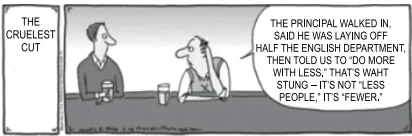
    Leia o cartoon.

    (https://www.writerswrite.co.za)


    As far as standard English is concerned, the teacher’s correction of the principal’s words “It’s not ‘less people’, it’s ‘fewer’” is

    Alternativas da questão 3172430
  19. Questão 139

    ID 3172429

    Disciplina: Língua Inglesa

    Assunto: Interpretação de Texto | Text Interpretation

    Ano: 2023 Banca: FUNDATEC - Fundação Universidade Empresa de Tecnologia e Ciências Órgão: Prefeitura Municipal de Três de Maio


    Instruction: answer questions 36 to 40 based on the following text.

    Why 2023 could be the year of the superbloom

    1. “Superblooms” of California and the U.S. Southwest are the stuff of (literal) legend.
    2. For centuries, Indigenous communities have celebrated massive springtime blossomings of
    3. chia, desert lilies, tarweeds, sunflowers, and other flowers with edible seeds or roots. “Fields
    4. as verdant as they are flower-covered touch the very waters of the sea”, wrote Spanish
    5. colonist Juan Bautista de Anza in 1774. Today, these floral explosions are confined to pockets
    6. of relatively undisturbed habitats, mostly in the vast southwestern deserts of California,
    7. Arizona, and Nevada, and pop up only after a good-rain year.
    8. This winter, California has seen an abundance of rain, which has fallen relatively
    9. consistently since late autumn. That’s setting the stage for an excellent bloom, says Abby
    10. Wines, a ranger at Death Valley National Park in southern California. “Although it may not end
    11. up being a superbloom, we’re predicting a well-above-average bloom”. But the glorious natural
    12. events are under threat — from hundreds of thousands of flower tourists who sometimes
    13. trample delicate blooms and soil; invasive species; ongoing development; and climate change,
    14. which is already making the region drier and hotter.
    15. Whether or not 2023 yields a superbloom, visiting spectacular flowers is a really
    16. excellent way “to get excited and start thinking about plants”, says Evan Meyer, director of
    17. the native plant-focused Theodore Payne Foundation. The “fragile, special, and in some ways
    18. dwindling experiences” can inspire deep relationships with the landscapes around us, he says
    19. — and get people involved in protecting them for the next bloom, some 10 years away.

    Available at: https://www.nationalgeographic.com/environment/article/2023-year-of-the-superbloom-flowers-california


    Which of the following statements is NOT mentioned by Evan Meyer, director of the native plant-focused Theodore Payne Foundation, regarding the visitation of flower fields?

    Alternativas da questão 3172429
  20. Questão 140

    ID 3172428

    Disciplina: Língua Inglesa

    Assunto: Notícias e Artigos Jornalísticos | News Articles

    Ano: 2023 Banca: DIRENS AERONÁUTICA - Diretoria de Ensino da Aeronáutica Órgão: Ministério da Defesa - Aeronáutica


    Read the text and answer questions 29, 30, 31 and 32.

    Passenger with no flying experience lands plane after pilot

    incapacitated

    A passenger without any flying experience safely landed a plane at a Florida airport after the pilot became incapacitated. The Federal Aviation Administration was investigating the incident. It was believed the pilot may have suffered a medical emergency. In a statement, the FAA said two passengers were onboard the single-engine Cessna 208 when the pilot had a “possible medical issue”. One passenger steered the private plane smoothly into Palm Beach international airport. According to LiveATC.net audio, the passenger told air traffic control: “I’ve got a serious situation here. My pilot has gone incoherent and I have no idea how to fly the airplane”. The air traffic controller then asked what his position was. He replied: “I see the cost of Florida in front of me and I have no idea”. “We’re trying to locate you”, the controller said. After four minutes, air traffic control located the plane, which was off Boca Raton. The controller proceeded to guide the passenger through the descent. In a video obtained by CNN, the plane can be seen landing slowly and smoothly. In a separate recording, another air traffic controller can be heard telling pilots: “you just witnessed a couple of passengers land that plane.”

    (Adapted from www.theguardian.com)


    According to the text, choose the alternative that is NOT correct.

    Alternativas da questão 3172428
Pular para o conteúdo principal