Banco de Questões

A ferramenta completa para a sua preparação em concursos

Questões de Língua Inglesa

35.421 questões encontradas

  1. Questão 261

    ID 3172307

    Disciplina: Língua Inglesa

    Assunto: Substituição de Palavras e Reescrita de Frases | Word Substitution And Sentence Rewriting

    Ano: 2023 Banca: FEPESE - Fundação de Estudos e Pesquisas Socioeconômicos Órgão: Prefeitura Municipal de Caxambu do Sul


    Generations

    Authors William Strauss and Neil Howe are known____________their theories about cycles___________ generations _____________American history. In their seminal Generations, and the subsequent 13th Gen, and The Fourth Turning, they explore the history of America_____________ 1584 to the present as a repeating cycle of 4 consecutive generational archetypes. They refer_____________ each cycle of four generations as a constellation, and they posit that each constellational era corresponds to “5 recurring types of historical events” and moods. They state that adjacent generations do not live similar lives, and that each generation ages as a singular cohort as time moves forward. If one were to place this progression on a graph, the line would form a diagonal – which Strauss and Howe call the “generational diagonal.” According to Strauss and Howe, each generation is comprised of people who possess: 1) common age, 2) common beliefs, and 3) perceived membership in the same generation. A generation is approximately 22 years in length. Since a lifetime may reach 80–90 years, members of 4 generations are alive at one time.

    The four generational archetypes identified by Strauss and Howe are Idealist, Reactive, Civic, and Adaptive. Idealists are “increasingly indulged youths after a secular crisis,” come of age “inspiring a spiritual awakening,” cultivate principle rather than practicality or pragmatism in midlife, and emerge as “visionary elders.” Reactives grow up “underprotected and criticized youths during a spiritual awakening,” mature into risk taking adults, unlike the preceding generation at midlife, mellow into “pragmatic midlife leaders during a secular crisis,” and become reclusive elders. Civics grow up “increasingly protected youths after a spiritual awakening,” become “a heroic and achieving cadre of young adults,” build institutions as midlifers, and “emerge as busy midlifers, attacked by the next spiritual awakening.” Adaptives grow up as “overprotected and suffocated youths during a secular crisis,” unlike the previous generation as young adults, become “risk-averse, conformist rising adults,” mature into “indecisive arbitrator leaders during a spiritual awakening,” and become sensitive elders.

    The authors believe that the archetypical generations have recurred in fixed order throughout American history with one exception: following the Civil War, one type did not appear. As each generational archetype shifts from one phase of life to the next, the succeeding generations line up in a predictably recurring pattern. For example, when the Idealists are elders, the Reactives are in midlife, the Civics are in rising adulthood, and the Adaptives are in youth.

    The central role of the elders, aged 66–87, is that of stewardship, such as supervising and mentoring. The central role of midlife, aged 44-65, is leadership, such as parenting and teaching. The central role of rising adulthood is activity, such as working and starting families. The central role of youth, aged 0 to 21 is dependence, such as growing and learning.


    In the following sentence:

    “They state that adjacent generations do not live similar lives, and that each generation ages as a singular cohort as time moves forward.”

    The correct definition for the word cohort is in:

    Alternativas da questão 3172307
  2. Questão 262

    ID 3172306

    Disciplina: Língua Inglesa

    Assunto: Sinônimos | Synonyms

    Ano: 2023 Banca: DIRENS AERONÁUTICA - Diretoria de Ensino da Aeronáutica Órgão: Ministério da Defesa - Aeronáutica


    Choose the best alternative to fill in the blank.

    ‘Once the foreign tourists arrive for the summer holidays, they cause a phenomenon that makes the population of Greece ______ in size.’

    Alternativas da questão 3172306
  3. Questão 263

    ID 3172305

    Disciplina: Língua Inglesa

    Assunto: Substituição de Palavras e Reescrita de Frases | Word Substitution And Sentence Rewriting

    Ano: 2023 Banca: IADES - Instituto Americano de Desenvolvimento Órgão: Secretaria de Estado de Educação do Distrito Federal


    1 That COVID warped our perception of time is well

    established. Studies show that stressful experiences tend to

    make it feel unclear how much time is passing, especially

    4 when one is confined to one’s home for months on end. This

    pandemic skip—the strange sensation that our bodies might

    be a step out of sync with our minds—happened to people

    7 of all ages. My skip, I realized, had carried me swiftly

    through what would have been my last couple years of

    socially permissible carelessness. And what I’d dropped into

    10 didn’t especially appeal, particularly after having been

    trapped in the house-cats-in-a-bag style for three years: real

    12 adulthood with all its attendant concerns.

    SCHNEIDER, Katy. The Pandemic Skip. The Cut. September 14th, 2023. https://www.thecut.com/article/post-covid-pandemic-age-essay. [adapted]

    Based on the text, judge the following items.


    “Out of sync” (line 6) could be correctly replaced by “equally” without changing the meaning.

    Alternativas da questão 3172305
  4. Questão 264

    ID 3172304

    Disciplina: Língua Inglesa

    Assunto: Consequência | Consequence

    Ano: 2023 Banca: ASSESSORIA E GESTÃO INTEGRADA EM RECURSOS HUMANOS S/C LTDA. ME Órgão: Prefeitura Municipal de Cunha


    Qual o significado da palavra sublinhada?

    The Livraria El Ateneo is a magnificent bookstore in Argentina. Therefore, you shouldn’t miss it.

    Alternativas da questão 3172304
  5. Questão 265

    ID 3172303

    Disciplina: Língua Inglesa

    Assuntos: Quadrinhos, Tirinhas e Charges | Comic Strips And Cartoons

    Ano: 2023 Banca: CESPE CEBRASPE - Centro de Seleção e de Promoção de Eventos UnB Órgão: Serviço Social da Indústria - São Paulo


    Internet: <www.thecomicstrips.com>.

    In the previous comic strip, the lady says that her husband is “full of baloney” because

    Alternativas da questão 3172303
  6. Questão 266

    ID 3172302

    Disciplina: Língua Inglesa

    Assunto: Non-defining Relative Clauses

    Ano: 2023 Banca: IADES - Instituto Americano de Desenvolvimento Órgão: Secretaria de Estado de Educação do Distrito Federal


    1 In the early days of political action on climate change

    adaptation was seen as, at best, a poor relation to cutting

    greenhouse-gas emissions—at worst as a distraction. In his

    first book on the subject, “Earth in the Balance” (1992), Al

    Gore, who became America’s vice-president the following

    year, described it as “a kind of laziness.”

    7 In 2010, with attempts to agree on reductions in

    emissions stalled by the failure of the Copenhagen summit,

    and with emissions rising steeply as the world bounced back

    10 from the financial crisis of 2007-09, adaptation began to

    11 take its proper place as a topic of international concern.

    Climate adaptation policies are needed more than ever. The Economist. May 30th, 2020. https://www.economist.com/schools-brief/2020/05/30/climate-adaptation-policies-are-needed-more-than-ever.

    Concerning syntactic and morphological aspects, judge the following items.


    The fragment “who became America’s vice-president the following year” (lines 5 and 6) is a non-defining relative clause.

    Alternativas da questão 3172302
  7. Questão 267

    ID 3172301

    Disciplina: Língua Inglesa

    Assunto: Notícias e Artigos Jornalísticos | News Articles

    Ano: 2023 Banca: EPCAR - Escola Preparatória de Cadetes do Ar Órgão: Ministério da Defesa - Aeronáutica


    Direction: Read the text below and answer questions 47 and 48 according to it.

    TEXT IV

    Anne Frank

    Second World War Diary Keeper

    I want to be useful or bring enjoyment to all people, even those I’ve never met. I want to go on living even after my death.

    5 Anne escaped the fear and hardship by writing in

    her red-and-white diary. Starting each entry ‘Dear Kitty’,

    she wrote about her dreams: she wanted to live in Paris

    and London, to wear beautiful dresses, and to become a

    journalist. She wrote about being hungry and bored. She

    10 wrote about her jealousy of Margot and arguments with

    her mother. She wrote about her feelings for seventeen-

    year-old Peter Van Pels and about their first kiss. She

    wrote about how gazing out at a chestnut tree through a

    silver of glass. But, most of all, she wrote about hope:

    15 hope that something would change and that she would be

    free once more. (HALLIGAN, 2018, P.105)

    (Source: HALLIGAN, K. Her story: 50 women and girls who shook up the world. Simon & Schuster Children’s Publishing Division, New York – 2018.)


    We can conclude that Anne Frank wrote about both

    Alternativas da questão 3172301
  8. Questão 268

    ID 3172300

    Disciplina: Língua Inglesa

    Assunto: Voz Passiva | Passive Voice

    Ano: 2023 Banca: FGV - Fundação Getúlio Vargas Órgão: Prefeitura Municipal de São José dos Campos


    Read Text I and answer the nine questions that follow it:

    Text I

    Multimodality in the English language classroom:

    A systematic review of literature

    Literacy in the 21st century is now no longer regarded simply as the ability to use a language competently in a mono-cultural setting. Literacy today involves students knowing how to navigate across an increasingly complex communication landscape and to negotiate a range of contexts and patterns of intercultural meanings as well as the prevalence of multimodal texts.

    Contemporary communication environment is characterised by multimodal meaning-making, that is the “multiplicities of media and modes”, as well as “increasing local diversity and global connectedness” (New London Group, 1996, p. 62) which necessitates a shift in the pedagogical approaches that are adopted by teachers. This is especially so in the digital age where a sole focus on language in literacy is no longer sufficient for the new workplace given that a revised sense of ‘competence’ is required. The recognition of social diversity also demands pedagogical approaches that engage with the transcultural and multicultural classroom. Issues of the day such as fake news and social justice concerns also need to be addressed in the literacy classroom.

    Multimodality focuses on understanding how semiotic resources (visual, gestural, spatial, linguistic, and others) work and are organised. Multimodality in education adopts an expanded view of literacy to include the range of multimodal communicative practices which young people are involved in today's digital age. Multimodal pedagogies refer to the ways in which the teacher can design learning experiences using a range of multimodal resources. It involves teachers making design choices in the ways in which the curriculum content is expressed, arranged, and sequenced multimodally. Multimodal pedagogies also involve designing opportunities for students to explore and perform ideas and identities using a range of meaning-making resources. The teaching and learning activities often involve drawing from the students’ funds of knowledge and their lifeworld. With multimodal pedagogies, teachers orchestrate the learning process by weaving together a series of knowledge representations into a cohesive tapestry and in so doing make apt selection of meaning-making resources to design the students’ learning experience.

    Adapted from https://www.sciencedirect.com/science

    /article/abs/pii/S0898589822000365


    The sentence that presents the verb form in the passive voice is:

    Alternativas da questão 3172300
  9. Questão 269

    ID 3172299

    Disciplina: Língua Inglesa

    Assunto: Prefixos | Prefixes

    Ano: 2023 Banca: Instituto AOCP Órgão: Instituto Federal do Maranhão


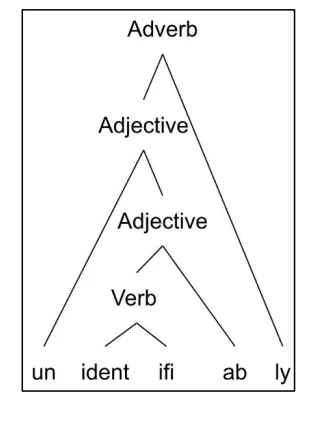
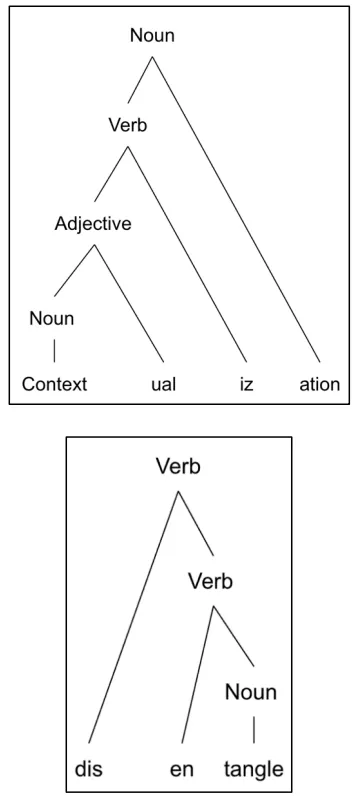
    Observe the morphological process of the formation of the following words:

    Now analyze the following statements.

    I. -context- and -tangle- are free roots, while -ident- is a bound root.

    II. These three words are formed both by prefixation and suffixation.

    III. In the noun, -ual- and -iz- are derivational suffixes, while in the adverb, -ifi- and -ab- are inflectional suffixes.

    IV. dis- and en- both have negative meanings.

    V. The head of the noun is -ation, the head of the verb is en- and the head of the adverb is -ly.

    The correct statements are

    Alternativas da questão 3172299
  10. Questão 270

    ID 3172298

    Disciplina: Língua Inglesa

    Assunto: Outros | Others

    Ano: 2023 Banca: QUADRIX - Instituto Quadrix Órgão: Conselho Regional dos Técnicos Industriais da Bahia


    Text for items from 31 to 40.

    1 Bahia, state of eastern Brazil, is bounded by Piauí and Pernambuco states to the north, by Alagoas and Sergipe states

    to the northeast, by the Atlantic Ocean to the east, by Espírito Santo and Minas Gerais states to the south, and by Goiás

    and Tocantins states to the west. The capital, Salvador, is a port situated at the southern tip of the peninsula that separates

    4 Todos os Santos (All Saints) Bay, a deep natural harbour, from the Atlantic Ocean. The Portuguese first entered the region

    in 1501, through the bay where Salvador is now located, and they called the area Bahia (“Bay”), whence the state derives

    its name.

    7 On All Saints’ Day, November 1, 1501, Portuguese explorers entered the bay on which Salvador now stands; they

    therefore named it Baía de Todos os Santos (All Saints Bay). The subsequent occupation of the vicinity by the Portuguese led

    in 1549 to the merging of four captaincies under the first governor‑general of Brazil, Tomé de Sousa, who in the same year

    10 founded Salvador as the seat of his government.

    The colonization of the territory began in the Recôncavo, where sugarcane and tobacco were grown for export

    and other crops raised for the settlers’ food. In the semiarid interior, cattle raising was considerably stimulated in the 18th

    13 century, when the discovery of gold and gems in the Diamantina Upland attracted more settlers.

    When the Empire of Brazil was proclaimed in 1822, Bahia was still controlled by forces loyal to Portugal, but on

    July 2, 1823, Brazilian troops occupied Salvador, and Bahia became a province of the empire. In 1889, under the republic,

    16 Bahia became a state of the Brazilian republic. During the 1890s a major messianic movement led by the charismatic preacher

    Antônio Vicente Mendes Maciel, known to his followers as Antônio Conselheiro (“Counselor”), and centred at the religious

    settlement of Canudos (in the arid interior of Bahia) was viewed as a subversive threat to the secular republic. It was bloodily

    19 repressed in 1897 in what became known as the War of Canudos. (This event has been immortalized by Peruvian author

    Mario Vargas Llosa as well as many Brazilian writers.)

    During the 19th century there was a revival of agriculture: it was the golden age for sugarcane, coffee was grown

    22 on a large scale, cotton production increased, and the forests of the south were turned into profitable plantations of cacao.

    Rubber plantations were developed at the beginning of the 20th century. By the turn of the 21st century, although agriculture

    remained important, the majority of the state’s income derived from industry, commerce, and tourism.

    Internet: <www.britannica.com> (with adaptations).

    Regarding the text and its linguistics aspects, judge the items from 31 to 40.


    The construction “When the Empire of Brazil was proclaimed in 1822, Bahia was still controlled by forces loyal to Portugal” (line 14) can be correctly rewritten as Bahia was still controlled by forces that were loyal to Portugal when, in 1822, the Empire of Brazil was proclaimed.

    Alternativas da questão 3172298
  11. Questão 271

    ID 3172297

    Disciplina: Língua Inglesa

    Assunto: Interpretação de Texto | Text Interpretation

    Ano: 2023 Banca: VUNESP - Fundação para o Vestibular da Universidade Estadual Paulista Órgão: Universidade Virtual de São Paulo


    Leia o texto e responda às questões de números 30 a 35.

    The twenties were strange and wonderful years in America. “The uncertainties of 1919 were over – there seemed little doubt about what was going to happen – America was going on the greatest, gaudiest spree in history.” These are the words of F. Scott Fitzgerald (1896-1940). Fitzgerald’s best books form a kind of spiritual history of the “Lost Generation” (a phrase first used by Gertrude Stein). Many young people in the post-World War I had ‘lost’ their American ideals. At the same time America ‘lost’ many fine young writers – like e.e. cummings and Hemingway – because they had moved to Paris.

    Ernest Hemingway was one of the writers who spoke for the lost generation. He drove an ambulance in WWI and then decided to become a writer. His first novel, The Sun Also Rises (1926), is a portrait of young adults living in the postwar era. The characters are young Americans living in Paris. Some have fought bravely for their country. But now they are completely useless in peacetime. Others in the novel are simply expatriates, people without a land.

    You´re an expatriate. You’ve lost touch with the

    soil. Fake European standards have ruined

    you. You drink yourself to death. You become obsessed

    by sex. You spend all your time talking. You’re an

    expatriate, you see? You hang around cafés.

    Without hope or ambition, they try to enjoy each day as it comes. All they want to know is how to live in the emptiness of the world. The typical Hemingway hero must always fight against the Nada (nothingness in Spanish) of the world. He must never give up trying to live life as fully as possible.

    (Peter High. Outline of American Literature. Essex, Longman. 1996. p. 146-7. Adaptado)


    A palavra “as” pode assumir uma variedade de significados em Língua Inglesa, a depender do contexto. Assinale a alternativa em que a palavra está relacionada às ideias de “quando” ou “à medida que”, conforme o trecho do quarto parágrafo “They try to enjoy each day as it comes”.

    Alternativas da questão 3172297
  12. Questão 272

    ID 3172296

    Disciplina: Língua Inglesa

    Assunto: Sinônimos | Synonyms

    Ano: 2023 Banca: Objetiva Concursos Órgão: Prefeitura Municipal de Passo Fundo


    The underlined word in "A fluffy cat curled up on the cozy blanket.” can be substituted, without loss of meaning, by:

    Alternativas da questão 3172296
  13. Questão 273

    ID 3172295

    Disciplina: Língua Inglesa

    Assunto: Metodologias e Abordagens de Ensino | Teaching Methods And Approaches

    Ano: 2023 Banca: VUNESP - Fundação para o Vestibular da Universidade Estadual Paulista Órgão: Escola de Formação Complementar do Exército


    Leia o texto para responder às questões de números 31 a 39.

    Most teachers recognise the need for the students’ awareness about the potential relevance and utility of the language and skills they are teaching. And researchers have confirmed the importance of this need.

    In ESP (English for specific purposes) materials, for example, it is relatively easy to convince the learners that the teaching points are relevant and useful by relating them to known learner interests and to ‘real-life’ tasks, which the learners need or might need to perform in the target language. In general English materials this is obviously more difficult; but it can be achieved by researching what the target learners are interested in and what they really want to learn the language for. An interesting example of such research was a questionnaire in Namibia which revealed that two of the most important reasons for secondary school students to wish to learn English were so they would be able to write love letters in English and so that they would be able to write letters of complaint for villagers to the village headman and from the village headman to local authorities.

    Perception of relevance and utility can also be achieved by relating teaching points to challenging classroom tasks and by presenting them in ways which could facilitate the achievement of the task outcomes desired by the learners. The ‘new’ learning points are not relevant and useful because they will help the learners to achieve longterm academic or career objectives, but because they could help the learners to achieve short-term task objectives now. Of course, this only works if the tasks are begun first and the teaching is then provided in response to discovered needs. This is much more difficult for the materials writer than the conventional approach of teaching a predetermined point first and then getting the learners to practise and then produce it.

    (B. Tomlinson, (ed). Material Development in Language Teaching. Cambridge: CUP. 1998/2011. pp 11-2. Adaptado)


    The “conventional approach” described at the end of the third paragraph is most typically found in courses which follow

    Alternativas da questão 3172295
  14. Questão 274

    ID 3172294

    Disciplina: Língua Inglesa

    Assunto: Interpretação de Texto | Text Interpretation

    Ano: 2023 Banca: ASSESSORIA E GESTÃO INTEGRADA EM RECURSOS HUMANOS S/C LTDA. ME Órgão: Prefeitura Municipal de Areias


    Text: “How my life has changed”

    I used to work on cruise ships as a musician. I traveled a lot! I spent the month before the first lockdown on four continents! I used to get up really early, drive to the airport and fly to a port across the world and get on a ship just to get to work! Then I used to spend between three and fourteen days on the ship. The ships were great. The food was excellent, and the staff was brilliant. The ship stopped at fantastic places, and I often used to spend the afternoon at the beach drinking cocktails or sightseeing. But there were disadvantages too. I often didn’t know anyone on the ship. But the passengers all knew me, and they used to talk to me every time I left my cabin. I didn’t have any privacy. Of course, I had to chat with them politely even when I wasn’t in the mood.

    But now, everything has changed. The cruises aren’t running now, and I don’t know when they will run again, and I’ve been in my flat for a year. I never used to spend much time here, and I haven’t spent a whole year in England for over twenty years! But I’ve enjoyed it. I bought a bike last year, and I’ve found some great beach cafes that I never used to know about. I also bought a campervan, and I drove around the coast. I always used to prefer beaches in the Caribbean and the Mediterranean to British beaches. The weather is much better for a start! But I found some beautiful places last year. I could park on the beach in some places and run straight into the sea! They were much less touristy and more peaceful than the places where the cruise ships go.

    I’m spending a lot more time alone now. I didn’t use to be alone much when I was working. But since the pandemic started, I have developed new relationships with people whom I didn’t use to know very well. I always used to prefer the company of entertainers and people who like to travel. I used to think that people with normal jobs were boring. But since last year, I’ve got to know some really interesting, strong, kind and caring people! So that’s been really valuable.

    Questions related to the text: “How my life has changed”


    Sarah is spending ____ at home than before.

    Alternativas da questão 3172294
  15. Questão 275

    ID 3172293

    Disciplina: Língua Inglesa

    Assunto: Interpretação de Texto | Text Interpretation

    Ano: 2023 Banca: DIRENS AERONÁUTICA - Diretoria de Ensino da Aeronáutica Órgão: Ministério da Defesa - Aeronáutica


    Read the text and answer questions 30, 31, 32, 33 and 34.

    Kate Bush “really moved” by ‘Running Up That Hill’ hitting N.º 1

    Kate Bush is “overwhelmed” by the renewed affection for her decades-old song, “Running Up That Hill.” The singer posted ___ statement to her website about how ___ 1985 track is being played everywhere after being featured on ___ latest season of “Stranger Things.” (...) Sadie Sink’s character, Max, listens to ___ track until her friends play it on repeat to help her find her way back.

    “By featuring ‘Running Up That Hill’ in such a positive light - as a talisman for Max (one of the main female characters) - the song has been brought into the emotional arena of her story,” Bush wrote. “Fear, conflict and the power of love are all around her and her friends.” (...) Billboard reports that “Running Up That Hill” hit No. 1 in the U.K. and Australia and has entered the U.S. Top 5. “I have to admit I feel really moved by it all,” Bush said of the news. “Thank you so very much for making the song a N.º 1 in such an unexpected and good way.”

    Adapted from https://edition.cnn.com/2022/06/21/entertainment/kate-bush-running-up-that-hill/index.html.


    According to the text, write T for true and F for false. Then, choose the alternative with the correct sequence.

    ( ) Kate Bush is glad her song is famous now but she fears it will bring too much conflict.

    ( ) “Running Up the Hill” is popular again due to a TV series.

    ( ) Max is a fictional character, just as Kate Bush is.

    ( ) “Running Up the Hill” is more than 20 years old.

    Alternativas da questão 3172293
  16. Questão 276

    ID 3172292

    Disciplina: Língua Inglesa

    Assunto: Falsos Cognatos | False Cognates

    Ano: 2023 Banca: CESPE CEBRASPE - Centro de Seleção e de Promoção de Eventos UnB Órgão: Serviço Social da Indústria - São Paulo


    The word “Actually” is a false cognate in comparison to Portuguese. All words below are examples of false cognates in comparison to Portuguese, except

    Alternativas da questão 3172292
  17. Questão 277

    ID 3172291

    Disciplina: Língua Inglesa

    Assunto: Consequência | Consequence

    Ano: 2023 Banca: SELECON - Instituto Nacional de Seleções e Concursos Órgão: Prefeitura Municipal de Nova Mutum


    Leia o texto a seguir:

    Top 10 Effective Methods of Teaching English

    Pallavi Pradeep Purbey

    Dec 5, 2022 |

    In the history of teaching languages, there are many teaching approaches and techniques, with some being more well-known and successful than others. Language teaching methods are reliant on and affected by various hypothesis of language learning. The historical backdrop of language teaching advances in multiple ways.

    There are a lot of methods of English teaching, and we've listed a few that are very famous and active methods.

    Grammar-cum-Translation Method

    The name itself explains the functionality of the grammar-cumtranslation method. The strategy of teaching English in grammar orientation depends on a ton of interpretation. The technique is the conventional or 'old style' method of learning a language. A few nations approach this teaching style. The fundamental thought behind this strategy is that the students become familiar with all grammar rules to translate various sentences easily.

    Many teachers recognize this technique as incapable since it does not include the spoken form of the language, and communication skills are ignored. Furthermore, it does not allow the learners to think directly in the target language. Thus, it hinders the creation of a direct link between thoughts and expression. Consequently, this technique doesn't improve the student's communicative ability in the language but only builds strong language writing skills.

    The Direct Method

    The Audio method is also known as the direct method, which involves thinking and speaking in English. Here the communication between the teacher and the student is strictly in English, and the student is barred from using their native language. This way, the student can get a stronghold on the accent and fluency, the frequency of grammatical errors in this would be less.

    This method is widely used as it helps the students learn the English language in a way a native English speaker would speak like and not the orthodox textbook way.

    The Audio-Lingual Method

    The audio-lingual method is also recognized as the Army Method. During the first world war, the American Armed forces started escalating oral courses known as the 'Military particular Training Program' (ASTP). Instructive organisations later received it as an audio-lingual method.

    The striking highlights of the audio-lingual method are:

    1. Language teaching starts with communication; the material is educated before it is offered in composed structure.
    2. The objective language is the study hall's main language; the student's primary language isn't utilised.
    3. The teacher is the role model for the student; student-tostudent interaction happens in chain drills.

    The army method is identified with the natural method. The most significant difference between the audio-lingual method and the natural method is its focal point of teaching. The natural method focuses on the learning of vocabulary, while the audio-lingual practice focuses on communication.

    Suggestopedia

    Suggestopedia is a behaviourist theory developed by Georgi Lozanov, the Bulgarian psychotherapist in the 1970s. The method involves using the environment, music, decoratives, etc., for learning the language.

    It depends a lot on the atmosphere and the physical environmental factors of the class. When teachers prepare to utilize the Suggestopedia method, there's a great deal of craftsmanship and music included. Each suggestopedia exercise is divided into three unique stages: Deciphering, Concert Session and Elaboration.

    The Silent Way

    The silent way leans mainly on the student's self-sufficiency. The teacher demonstrates only as a facilitator attempting to urge students to be more efficient in their learning. The fundamental of these lines of teaching is for the teacher to state practically nothing so that students can assume responsibility for their education.

    This learning method follows a basic schedule, grammar, vocabulary, and pronunciation continually drilled and reused for support. The teacher assesses their students through their mistakes, and they may never set a conventional test as students are urged to address their language blunders.

    Total Physical Response

    Total Physical Response, also called TPR, is a methodology that follows 'learning by doing. For example, apprentices will learn English through a series of activities, “Close the door”, “Stand up”, “Open your book”, and “Stroll to the window and open it.” With TPR, the most significant aptitude is aural perception, and everything else will be regular.

    Community Language Learning

    Community language learning is a language-teaching approach in which students cooperate to create what parts of a language they might want to learn. It depends on the counselling approach. CLL is most likely one of the English teaching methods where the student feels the most secure. There's an extraordinary accentuation on the relationship and bond between the student and teacher. In contrast to a ton of different methods and ways to deal with teaching English as a Second Language, a great deal of the native language is utilized for translation purposes.

    Communicative Language Teaching

    The thought behind this methodology is to assist students with conveying all the more successfully and effectively in sensible circumstances that they may wind up. Therefore, this teaching includes concentrating on important capacities like thanking, complaining, suggesting, inviting, and requesting directions to give some examples.

    Communicative Language Teaching has the following qualities:

    1. The point is to make the student achieve communicative capability, for example, utilizing language precisely and appropriately.
    2. Communicative Language Teaching underscores the elements of a language rather than the principles.
    3. Utilize techniques to energize student cooperation in typical habitats- information gap exercises, role-play, group, and pair work.

    Task-Based Learning

    Task-based language teaching is also called task-based instruction. The principal point of this way to deal with learning is task finishing. Typically, the teacher sets relevant and exciting tasks. Then, students are required to draw on their information in English to finish the job with as few mistakes as could be expected under the circumstances. Such assignments can incorporate visiting a specialist, directing a meeting, or calling customer care for help.

    Lexical Approach

    The lexical approach in language teaching looks to create a proposition for a schedule plan and language teaching established on a view of language in which lexis assumes a focal job.

    The Lexical approach depends on computer studies that have recently distinguished the most customarily utilized words. This approach in teaching centres around vocabulary is securing and teaching lexical lumps arranged by their recurrence and use. Teachers of the Lexical Approach place an extraordinary accentuation on bona fide materials and practical situations for increasingly important learning.

    Adapted from: https://www.getmyuni.com/articles/methods-of-teaching-english. Acesso em 10/01/2023


    No trecho “Thus, it hinders the creation of a direct link between thoughts and expression...”, a conjunção thus foi usada com o sentido de:

    Alternativas da questão 3172291
  18. Questão 278

    ID 3172290

    Disciplina: Língua Inglesa

    Assunto: Adjetivos com -ed e -ing | -ed And -ing Adjectives

    Ano: 2023 Banca: VUNESP - Fundação para o Vestibular da Universidade Estadual Paulista Órgão: Universidade Virtual de São Paulo


    Leia o texto e responda às questões de números 37 a 45.

    Interactive Lecture:

    Small Changes for Improved Engagement and Learning

    Traditionally, undergraduate education has been predominately lecture-based instruction and passive lecturing continues to be the most widely used instructional strategy. However, educational research over the past decades has shown that students retain more course content when active learning techniques are correctly implemented. Furthermore, evidence shows that active learning lessens learning and achievement gaps for historically marginalized students.

    One method for starting the shift to active learning is the use of interactive lectures, those that incorporate short activities that give students opportunities to engage with the materials just covered in class. The main advantages of interactive lectures for instructors are the ease of implementation and the variety of activities that can be explored and incorporated into a course. Students benefit through increased engagement, learning, and long-term retention of course ideas, topics, and materials (Ernst and Colthorpe 2007, Revell and Wainwright 2009, Miller et al. 2013, Hadie et al. 2018).

    So, how do you create an interactive lecture?

    The preparation for an interactive lecture begins with revisiting the student learning objectives. Student learning objectives are key to determining which topics are essential to the course and aids in attending to these ideas, materials, and topics for lectures.

    Once you are clear on the learning objective(s), review the topic content to determine which aspects of the lecture are key points or required topics and which can be eliminated or covered using methods such as textbook readings, introductory videos, homework assignments etc.

    Finally, determine the smallest units of content that can be given and remain coherent. For each small section of information, reframe the content to answer a question. Use awareness-raising questions for structuring lectures; this will allow many strategies to be employed to increase student engagement through analysis and discussion. You could use one same question and have students brainstorm possible answers in pairs or small groups. The method helps students determine their prior knowledge and has them think critically about the topic.

    (Michele Larson. https://teaching.unl.edu, 24.05.2022. Adaptado)


    In the noun phrase “awareness-raising questions”, in the last paragraph, a compound adjective modifies the noun. A present participle compound adjective is also correctly used in the sentence in alternative

    Alternativas da questão 3172290
  19. Questão 279

    ID 3172289

    Disciplina: Língua Inglesa

    Assunto: Verbos Frasais | Phrasal Verbs

    Ano: 2023 Banca: FUNDATEC - Fundação Universidade Empresa de Tecnologia e Ciências Órgão: Prefeitura Municipal de Espumoso


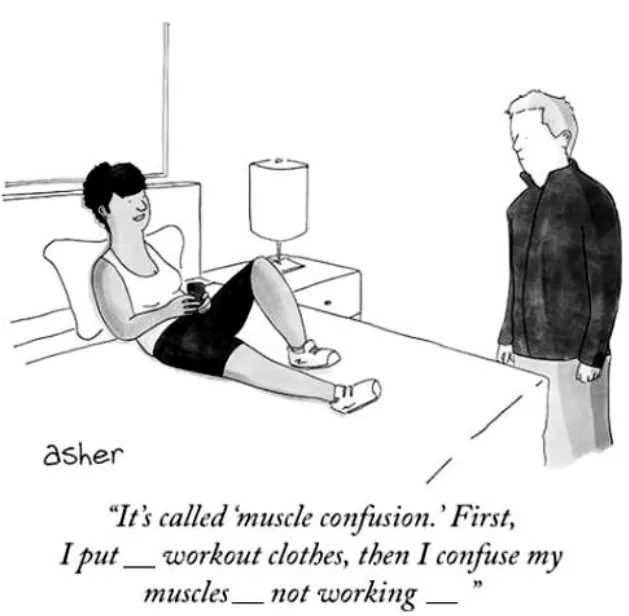
    In the cartoon below we see two people, and the one on the bed is explaining to the other: “It’s called ‘muscle confusion’. First, I put __ workout clothes, then I confuse my muscles __ not working __”.

    Source: @newyorkercartoons

    Mark the alternative that fills out, correctly and respectively, the gaps in the sentences above.

    Alternativas da questão 3172289
  20. Questão 280

    ID 3172288

    Disciplina: Língua Inglesa

    Assunto: Aquisição de Segunda Língua | Second Language Acquisition

    Ano: 2023 Banca: SELECON - Instituto Nacional de Seleções e Concursos Órgão: Secretaria de Estado de Educação de Mato Grosso


    TEXT:

    How do people overcome fossilization and achieve nativelike fluency in second language acquisition?

    There are a lot of common misconceptions about fossilization and language development. It's impossible to correct all of them in a post here, but I'll address a few that have been mentioned below.

    Fossilization is a stage at which a second language speaker seems to cease making progress toward becoming more targetlike in his or her use of the language, so a "learning plateau" is a reasonable analogy. The comparison wherein "the L2 learner has his own linguistic system" that's still influenced by L1 and other things is known as the "interlanguage." The question researchers cannot conclusively answer is whether or not that "plateau" is reversible after a certain point, be it age, fluency level, etc., in order to start making progress again.

    Different people are motivated by different things, which range from need (to pass a test, to get a job, to watch movies without subtitles, to make friends, etc.) to learning style (preferring to study from texts, liking/disliking impromptu, small-talk with people just to practice, preference for/against learning formal rules, and aptitude). It is easy to remember verb conjugations. There is no single formula.

    Finding someone who can correct your errors tactfully and effectively most certainly does not need to be demotivating, depressing or draining whatsoever. I'm a very fluent non-native speaker of Spanish, and I actively request that my native speaker (NS) friends correct me when I make a mistake, or use a phrase that sounds funny in their dialect, etc. How else will I learn? It's fascinating to learn little details like that now after so many years. As long as they don't do it in a mocking or condescending way, or at a socially inappropriate time, why wouldn't I want their help? Of course, if you correct a beginner every time they try to utter a sentence, it could be discouraging - and obnoxious - but everything in moderation.

    One of the biggest cognitive challenges is whether or not L2 speakers can learn to consciously notice differences between their L2 efforts and the way a NS talks. There are decades of research on this (my own included) and I'll gladly give references if anyone actually cares. Noticing falls into two broad categories. First, the ability to "notice the gap," i.e. hear a NS say a sentence and think, "Hmm, I understand what he meant but I've never heard that word before; it must mean ___" or "I know what he meant but it would not have occurred to me to say it that way; I'll try to remember that for later." The second is the ability to "notice the hole," i.e. when the L2 learner is trying to speak/ write and realizes that his "interlanguage" lacks a word, sound or structure needed to accurately convey his own thought. If he can seek the input necessary to fill the hole, he has a much stronger chance of acquiring it. The thought processes involved during that moment are holding the forms (or lack thereof) in working memory, and the longer it stays there for further processing, the greater the possibility that it is retained in long-term memory for later use. The NS interlocutor can help promote noticing through corrective feedback (also a subject of decades of research, for which I'm also happy to provide resources if anyone is genuinely interested.)

    I have been using a variety of strategies for years as a language coach when working with my clients, whether helping IT executives from India and Egypt learn to write more grammatically accurate e-mail or helping priests from Nigeria improve prosodic aspects of their pronunciation (i.e. stress and intonation patterns.) Each person is different. I have found no evidence to support the argument that a person who has fossilized cannot begin to make progress again toward a more target-like L2 use at least in some areas, with the right motivation, input and effort. The question is only about how much progress, in what areas, in how much time, and through what methods.

    Adapted form: https://www.quora.com/How-do-people-overcome-fossilization-and-achieve-native-like-fluency-in-second-language-acquisition Acesso em 22/09/2023


    De acordo com o texto, a fossilização pode ser definida como um:

    Alternativas da questão 3172288
Pular para o conteúdo principal